
Simple Journal
Simple Journal is a continuous journal for Obsidian. Days run newest to oldest in one scrolling timeline, every entry is an ordinary Markdown note in your vault, and you edit them all where you read them. It is in the community plugin list, at obsidian.md (opens in a new tab).
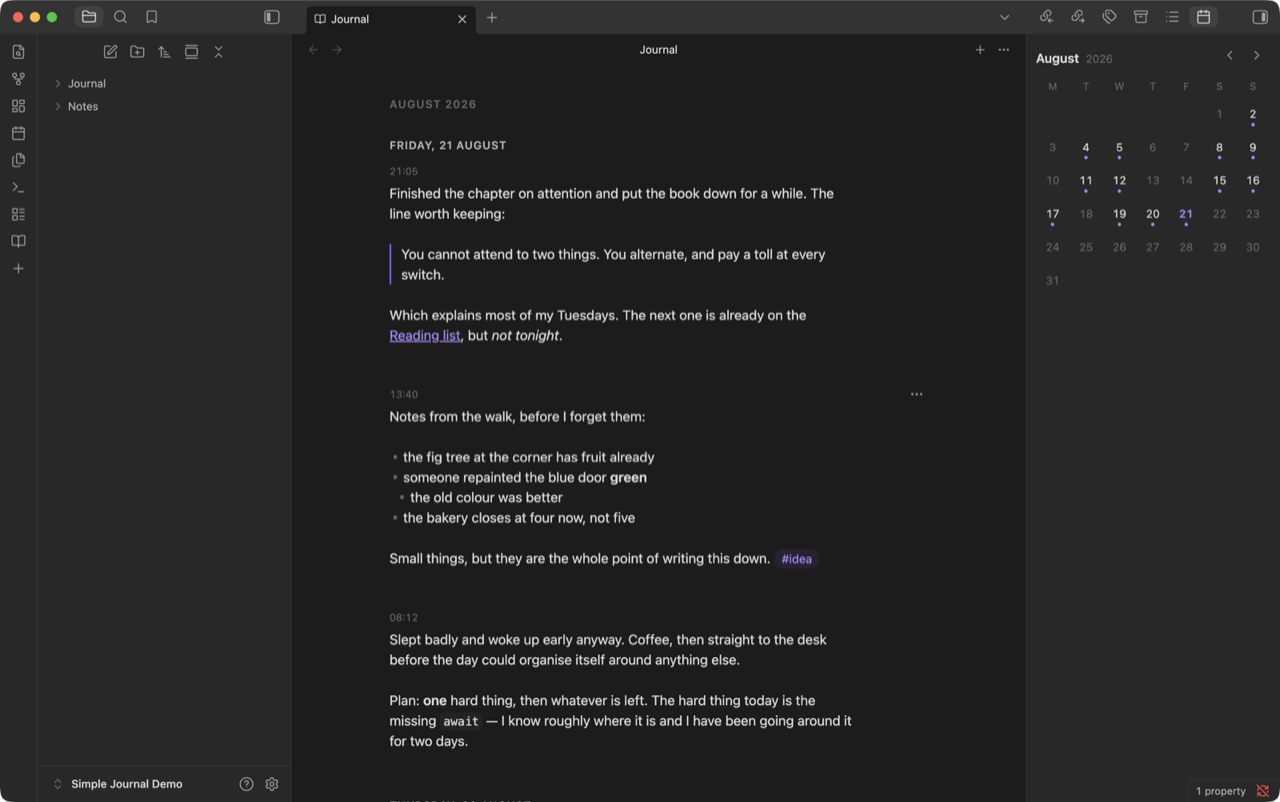
Entries have no titles
Nothing asks you for a name, a folder or a date. An entry is identified by the second it was written, and the file is named accordingly — 2026-08-12-09-34-21.md, one created property, your text, no heading added. It is the same decision Lite Journal makes for the same reason: naming a thought is a separate task from having it, and asking for the name first is how the thought gets away.
Everything downstream of that choice is ordinary. Links, tags, properties, search, backlinks, the graph, Dataview — they all work, because there is nothing special about the files. The plugin owns the timeline, not your notes.
A journal, put that way, is a filtered and sorted list of notes with a date on it. That observation is what Simple Streams was built out of: the same shape, with the filter left up to you.
The cost of no titles, and where it was paid
Titleless entries have exactly one place where they hurt, and it took until the third release to fix it. Obsidian's backlinks pane lists a backlink by filename. When every filename is a bare timestamp, a person you had written about twenty times appeared as twenty near-identical rows. The one place titleless entries actually cost you something was the one place you most wanted to read them back.
So mentions do not show links. They show the entries themselves, with their text, in the journal's own newest-first shape — in a sidebar panel, in a block you drop into any note, or appended under a note automatically. Click an entry's time and the journal opens there, which is where editing belongs.
One undocumented internal, and what makes it safe
The timeline's central promise is that an entry is a real Obsidian editor: link autocomplete, live preview and editor commands, not a click-to-edit approximation. Obsidian exposes no public API for that — an editable editor embedded in a custom view is not something a plugin is supposed to be able to do.
It does it anyway, through an internal mechanism, against an otherwise strict rule about not touching undocumented internals. Two things make the exception defensible rather than reckless. The internal is probed once when the plugin loads, and if it is not there the journal falls back to a plain textarea and says so once — you lose fidelity, never data. And every line that touches it lives behind one interface in one file, so the day Obsidian changes it, or publishes a real API, adapting is a single-file edit.
The empirical contract it was built against is written down in the repo rather than carried in someone's head.
It hardly writes anything
Each of the last releases states, in its own notes, that it adds no writes at all. Tags are read, never written — the plugin will not tag an entry for you and will not rewrite a tag you wrote. The mentions panel is read-only by construction. Deleting an entry goes through Obsidian's own trash flow, so it obeys whatever your vault is configured to do rather than inventing its own answer.
The one deliberate exception is changing an entry's time, and it exists because of a different decision: the timeline hides the properties panel, so a wrong timestamp would otherwise have no remedy from where you are reading it. It rewrites the created property and nothing else, leaving every other property exactly as you left it.
The release notes say what has not been tested
This is the part I would point at. Every release ships a Known limitations section, and it is not a formality — it names things that are unfinished, unverified, or simply unknown:
- That none of it has been run on a phone or a tablet, in a plugin that declares mobile support. The touch behaviour was reasoned from documented behaviour and has never been observed on a device.
- That whether links written in properties are counted as mentions "has only been reasoned about, not observed" — the plugin asks Obsidian which links a note has and trusts the answer.
- That with Vim bindings on, what Esc does in a new entry depends on which handler Obsidian reaches first, and which one that is has not been checked.
- That the note footer reaches into Obsidian's own layout, and if a future version changes it the panel stops appearing silently — no error, no notice, nothing altered in your notes. The silence is deliberate; the notes say so, and then say why on a phone it is indistinguishable from the setting being off.
A release note is usually an advertisement. Writing down the parts you have not verified costs you something in the short term and is the only version of the document worth trusting later. İnteraktif Matematik keeps the same list in its repository rather than its release notes, dated and measured, down to reporting a test suite as two hundred and forty of two hundred and forty-one.
Where it is now
Seven releases since August 2026, the newest being 1.2.0. A search command is written and not yet released; its casing rules are Turkish-aware, so a search for istanbul will find İstanbul — along with the honest consequence that English's capital I folds to a dotless ı, so “i am” will not find “I am happy”. It is a plugin for one way of journalling and is not trying to become a second one. Install it from Obsidian's community plugins, or read the source on GitHub (opens in a new tab).